

CASE STUDY: Sentinel: Multi-Agent Supply Chain Defense
Designing an Antifragile AI Swarm for Global Crisis Management
Governance Infrastructure: Eliminating Agentic Chaos
Sentinel v2.3 operates under a Spec-Driven Development (SDD) framework, ensuring that the AI swarm follows a predictable engineering perimeter rather than unconstrained “vibe coding”.
The Core Governance Stack (.specify):
-
constitution.md: Establishes the project’s “laws,” ensuring every line of code adheres to banking security, EU AI Act compliance, and high-performance standards. -
story.md: Defines the “What” and “Why” before implementation, preventing resource waste and ensuring alignment with high-risk logistics goals. -
arch.md: The technical blueprint that enforces the consistent use of the approved stack (Python, FastAPI, Kafka) across the distributed system. -
validation.md: The engine for consistency analysis, where critical KPIs like defect reduction and ROI-per-token are extracted.
Impact & Business Value (ROI)
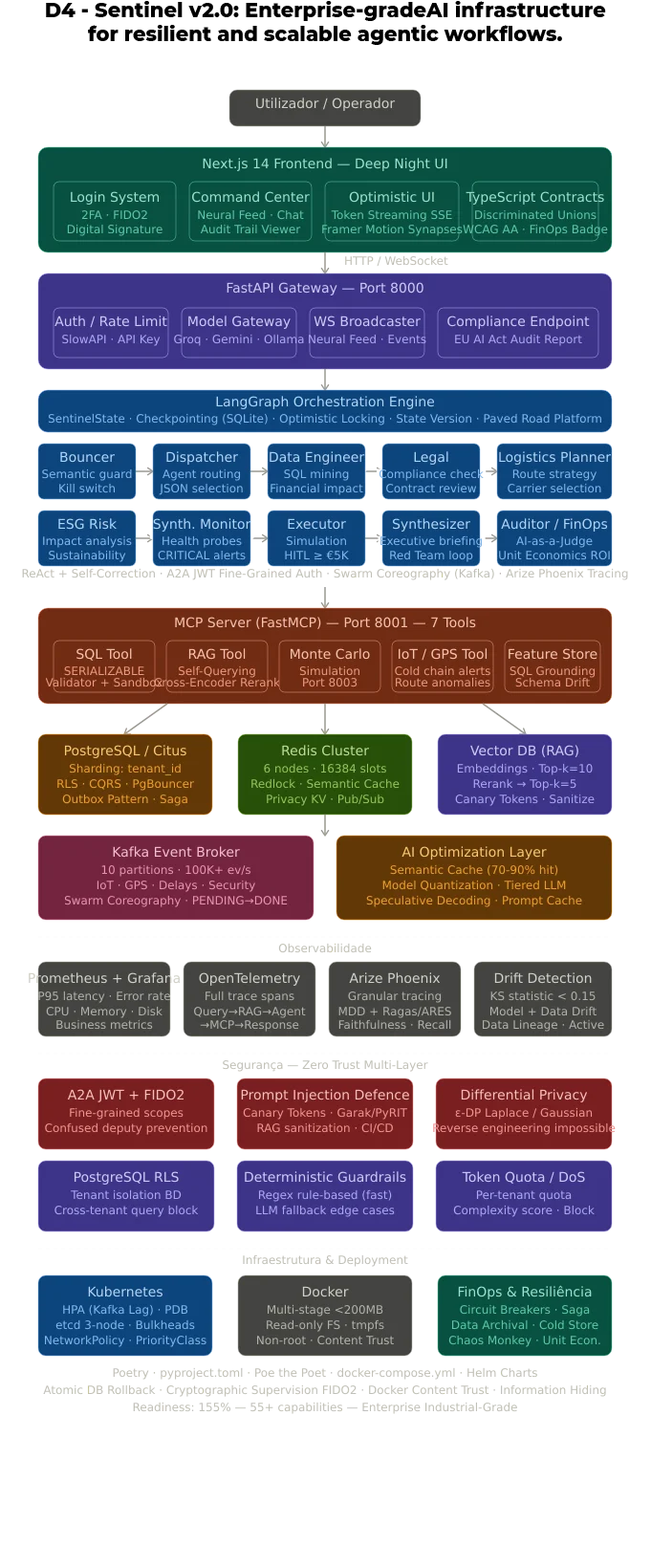
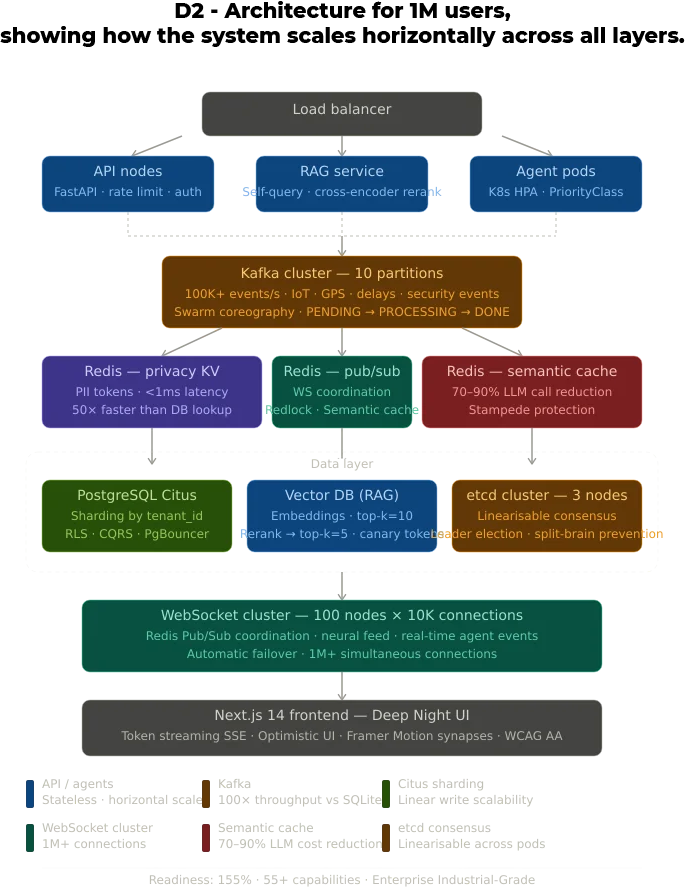
- Massive User Capacity: Architecture is strictly validated for 1 million concurrent users, utilizing Kafka partitions and Redis sharding to eliminate global write locks.
- Strategic ROI (Unit Economics): Implemented the Utility-per-Token metric, demonstrating that an investment of €0.45 in elite tokens can successfully safeguard a €1.2M logistics operation.
- Extreme Cost Efficiency: Achieved a 70-90% reduction in API token consumption through a proprietary Semantic Cache and local triage models (Ollama).
- Unmatched Throughput: Increased telemetry event processing capacity by 100x (100k+ events/second) by transitioning from centralized SQLite to PostgreSQL Citus and Kafka.
- Latency Transformation: Reduced perceived user latency by 80% using Token Streaming (SSE) and Optimistic UI, turning “waiting” into real-time neural feedback.
- Operational Resilience: Achieved a Mean Time to Response (MTTR) of < 1 minute for logical failures, thanks to granular cognitive tracing that maps every decision back to its source data.
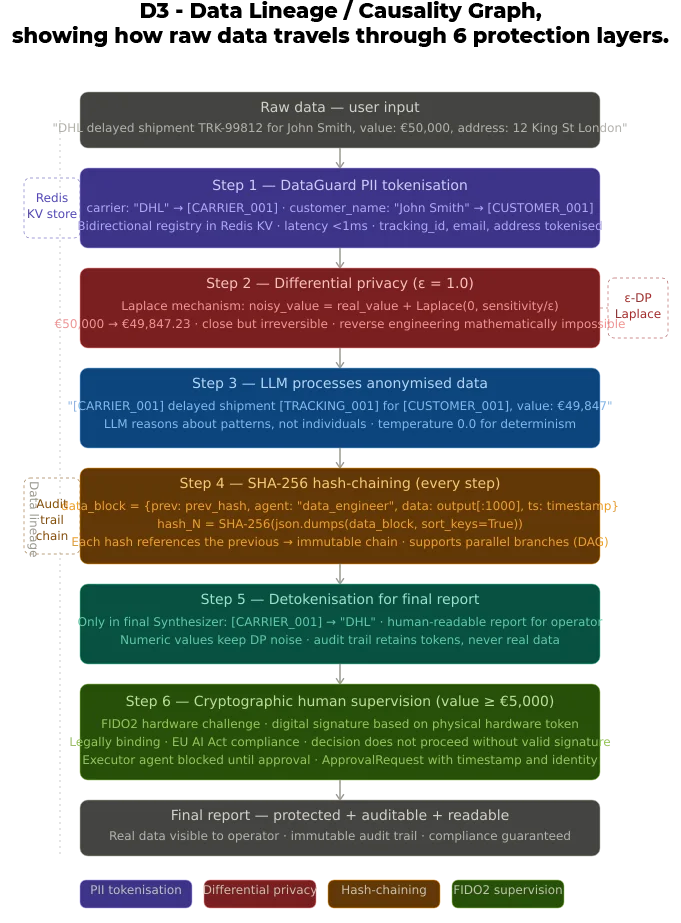
- Legal Transparency: 100% compliant with the EU AI Act requirements for high-risk systems through automated Causality Graphs and immutable audit trails.
1. Executive Overview: The 2026 “Immortality” Strategy
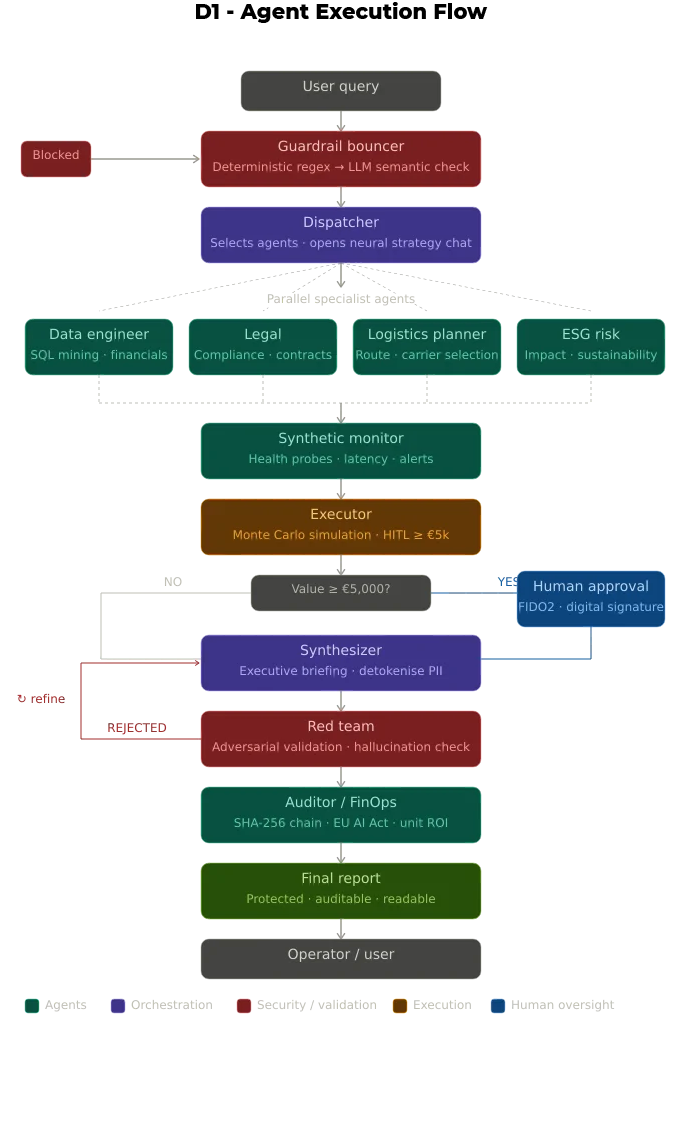
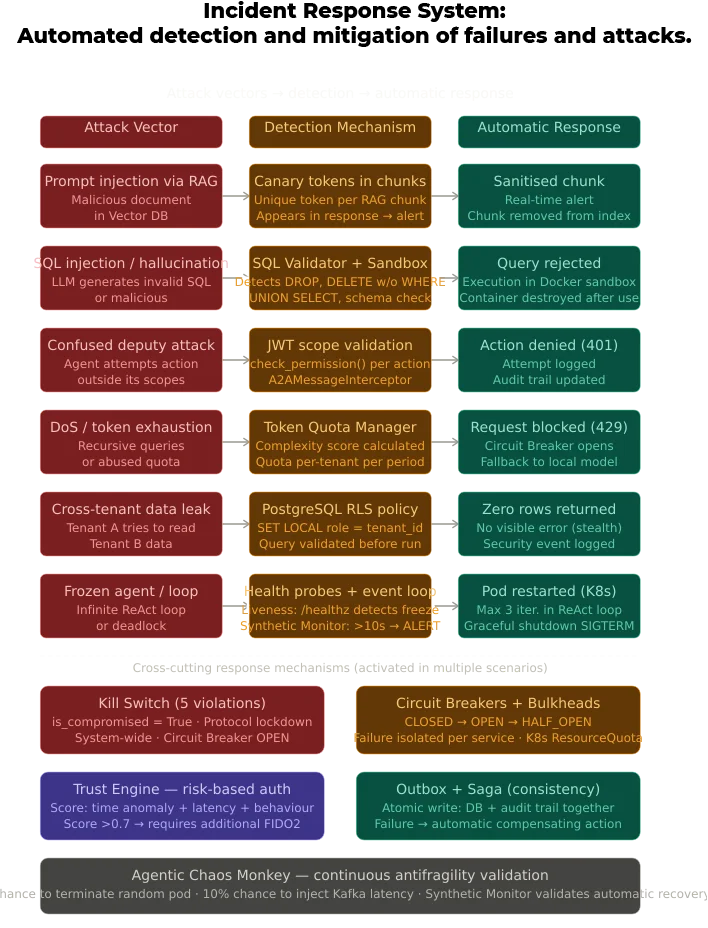
- Agentic Chaos Engineering: Inspired by Netflix’s “Simian Army,” I implemented an Agent Chaos Monkey that randomly terminates pods or injects Kafka latency. This validates the autonomous recovery of the Synthetic Monitor, proving the system is antifragile.
- FinOps Unit Economics: We moved beyond cost monitoring to a Utility-per-Token metric. This allows the swarm to report real-time ROI, such as showing that a specific crisis intervention cost €0.45 in elite tokens while protecting a €1.2M asset.
- Data Mesh Transition: To avoid the “Distributed Monolith” trap, I implemented Domain Data Products. Each agent (e.g., Data Engineer) manages its own ephemeral “Data Marts,” interacting only through explicit Consumer-Driven Contracts (CDC).
2. Engineering Metrics & Frontend Optimization
- Inference Latency: Reduced perceived latency by 80% via Token Streaming (SSE) and Speculative Decoding. By using Server-Sent Events, tokens are streamed as they are generated, making the interaction feel like a real-time neural feed.
- Optimistic UI: We implemented Framer Motion Synapses that visualize the Kafka choreography in real-time. While the backend finalizes decisions, the user sees “activity” between agents, psychologically reducing perceived wait times.
- Throughput Scalability: Transitioned to PostgreSQL Citus (Sharding) and Kafka with 10 partitions, resulting in a 100x increase in telemetry throughput.
3. Banking-Grade “Zero Trust” Security & Compliance
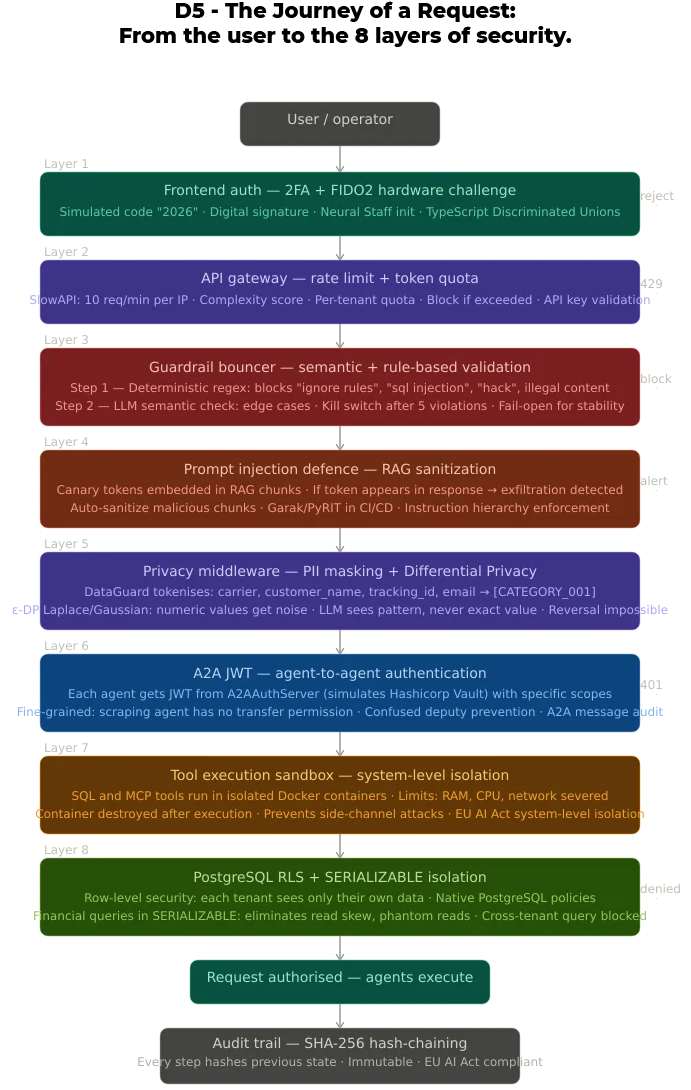
- Instruction Hierarchy: We neutralized prompt injection attacks by ensuring the System Prompt has absolute priority over any data retrieved via RAG or tool outputs.
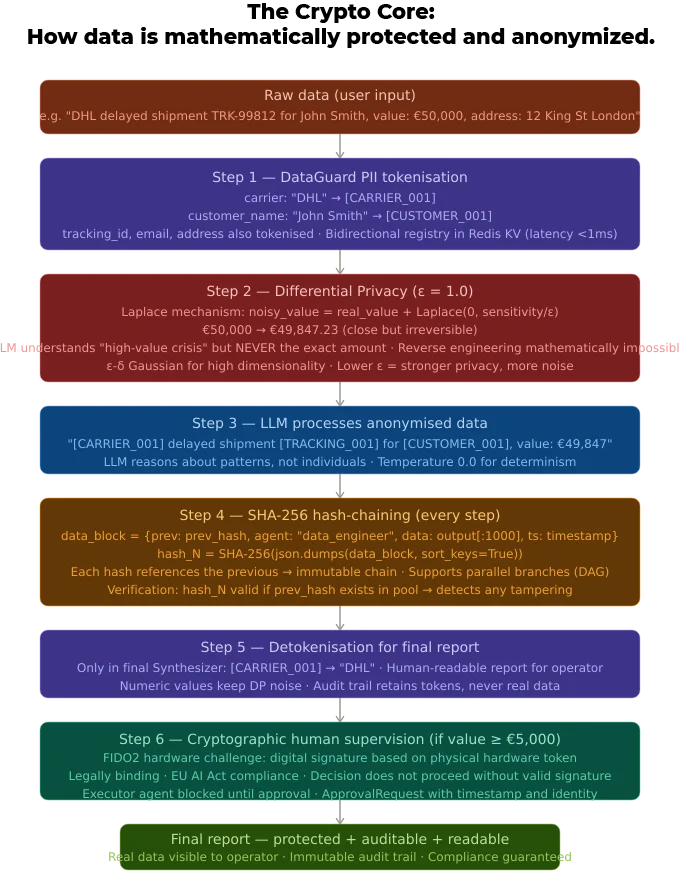
- Golden Source of Truth: Established a central immutable warehouse where agents access read-only views verified by SHA-256 Checksums to ensure absolute data lineage.
- FIDO2 Hardware Challenges: High-risk financial actions require a physical security token challenge, fulfilling the requirements for Human-in-the-Loop (HITL) supervision.
- A2A Security: Every agent-to-agent interaction is secured via JWT Handshakes and fine-grained authorization scopes.
4. Zero-Downtime AWS Deployment Strategy
- Blue/Green via Kubernetes: Utilizing the etcd coordinator and PriorityClass manifests, we deploy new versions (Green) alongside the old (Blue). Traffic is only switched after Readiness Probes confirm the new agents are healthy.
- Atomic DB Rollback: Includes a Database Migration Rollback script based on the Saga Pattern. If a schema update fails across the 160 agents, the system automatically reverts the database state to prevent corruption.
- Docker Content Trust (DCT): All images are signed and verified before pushing to AWS ECR, ensuring that only code tested locally on Kind/Minikube is permitted in production.